Tank dishwasher vs fresh water dishwasher
A tank dishwasher contains a tank of heated water, which it reuses 20-35 times. It does a final rinse at 80 degrees with fresh water. They can typically handle washing programs down to 1.5 minutes. The disadvantage is that it often requires space for external water treatment and soap/rinse aid in canisters. You also have to rinse the dishes before loading them, which requires additional space.
A fresh water dishwasher uses fresh water every time, and can handle programs down to about 15 minutes. They are popular in offices and small kitchens where there is not much need. The advantage is that they are easy (works like the household dishwasher at home) and they do not take up much space, because they typically have integrated water treatment and soap dosing. You also do not need to rinse the dishes beforehand.
Undercounter sink for office
Many small offices choose a domestic machine for private use, but many cannot wait an hour or two to have the dishes washed. That is why it is a good idea for many to invest in an industrial dishwasher that can be placed under a countertop. This is what is called an undercounter dishwasher. We have developed an entire dishwashing station for offices , where there is a sink and space for an undercounter dishwasher and a softener bottle, if needed.
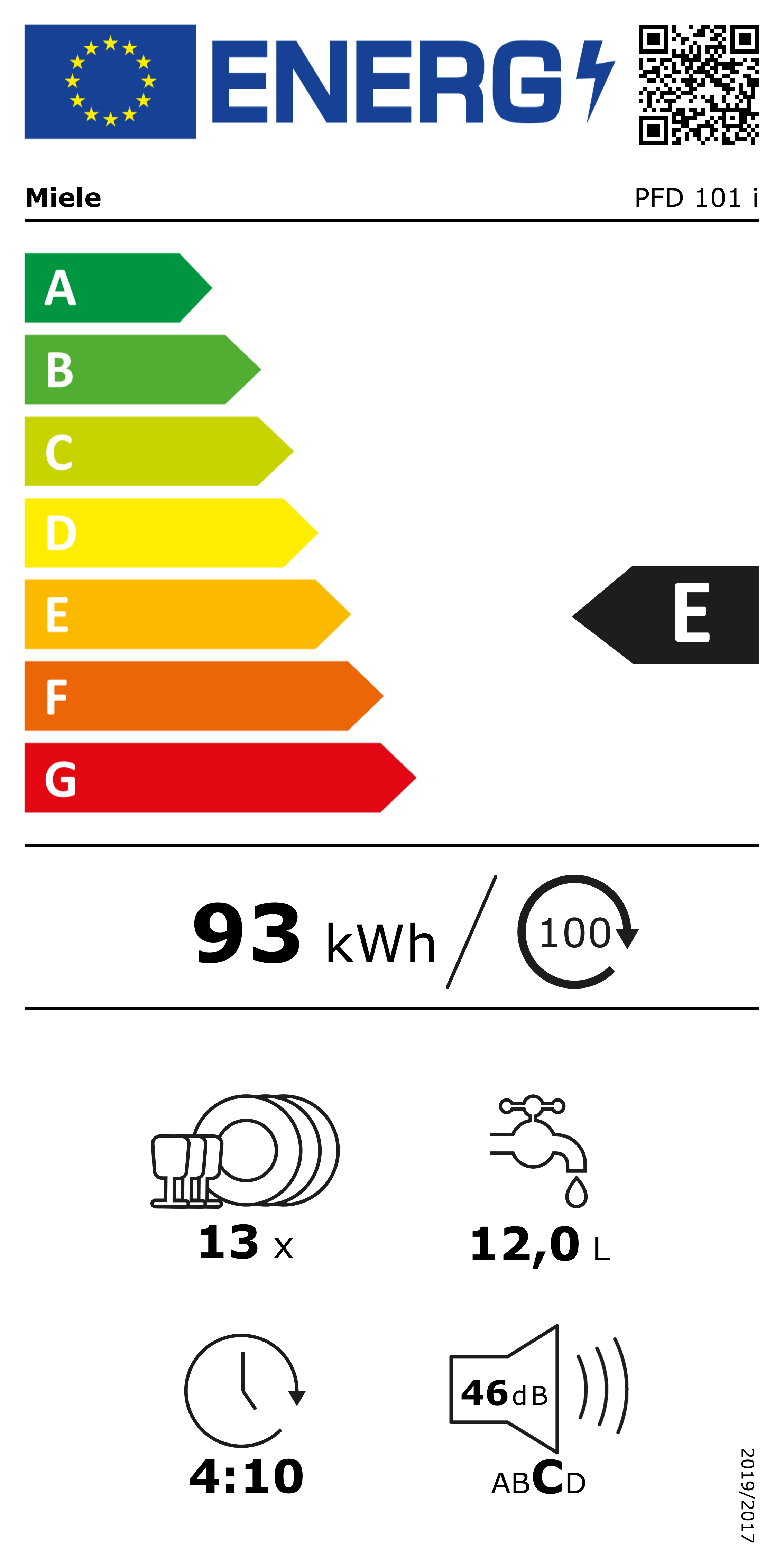
For smaller offices with a maximum of 2-3 washes per day, we recommend the PFD series from Miele. If you have a greater need than that, you should upgrade to a Miele PFD 404 , which washes in 14 minutes. What they have in common is that they pre-rinse the dishes and dry them after washing. This means that you don't need as much counter space.
A typical undercounter dishwasher cannot rinse or dry the dishes, so they come out wet and have to drip somewhere. This requires counter space!
In addition, there are many undercounter dishwashers that are of the tank type, which reuse the water for multiple washes. Therefore, you have to rinse the dishes before putting them in the dishwasher. This requires a spray arm and a large sink. All of this is not exactly office-friendly. Another advantage is that it does not require space for a softener bottle and cans of soap/rinse aid . Softening is integrated just like in a household machine.
An alternative to this model is the slightly more expensive Hobart FPS-10B Vapo Rinse , which also has a drying function and built-in softener. It also has quick wash programs down to 80 seconds and uses only 1 liter of water per rack.
A cheaper solution, at least in the short term, is the Jeros 950 , which is a classic undercounter dishwasher. It also has an integrated descaling system, but requires some cabinet space for the detergent and rinse aid canisters. It washes in as little as 2 minutes, but does not have a pre-rinse or drying function.
Undercounter dishwasher for institutions
Many small institutions will benefit just as much from the Miele PG 8059 and Jeros 950 as offices. The needs are about the same as they do not have as much space and the amount of service is limited. On the other hand, time is scarce, and you save many working hours by choosing an almost self-driving model like the PG 8059.
In nurseries and kindergartens, however, it is also important that there is a child safety lock. The Miele PG 8059 is one of the few models that has this. It cannot be opened as long as it is running. And remember that it has a final rinse of 80°C hot water.
Undercounter dishwasher for café and restaurant
Cafés and restaurants are better equipped for a regular industrial undercounter dishwasher because there is a pre-rinse table and drying can be done on a tray rack. There is also space for canisters of soap/rinse aid and a large softener bottle.
Final rinse requirements
The Danish Veterinary and Food Administration sets requirements for cleaning and disinfection in a dishwasher. Disinfection (final rinse) must be carried out with water that has a temperature of at least 80°C .