


Energy labeling on industrial refrigerators and freezers
Correct energy labeling of some types of industrial refrigerators and freezers is a legal requirement. As a retailer, we have to illustrate a refrigerator's energy label, which we receive from the manufacturer here on the website and everywhere else we market them.
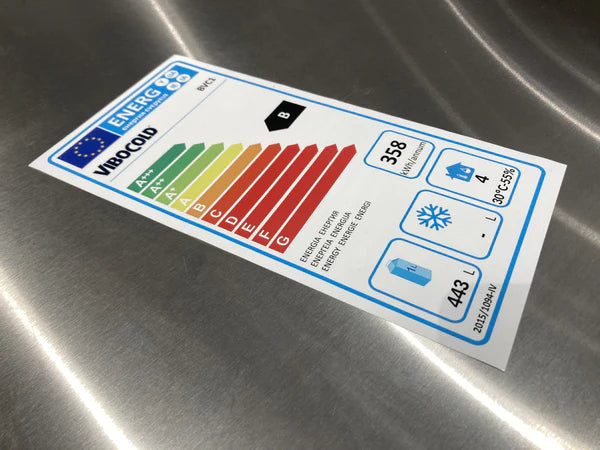
What is an energy label?
According to EU regulation 2019/2018, energy labels must use a scale from A to G, where G is the worst, to give the consumer a clear indication of the refrigerator's energy level. The labels provide information about the product's:
- energy efficiency class
- energy consumption
- volume or viewing areas in the rooms
- room temperature
For beverage coolers and ice freezers, the labels also show the maximum ambient temperature.
The rules change continuously, and therefore we continuously update energy labels as soon as we are informed by the manufacturer/importer.
In the commercial kitchen industry, we use two different types of energy labels:
1. A to G: refrigerators and freezers for direct sale (e.g. display refrigerators)
This classification goes from A to G and must be used on mains-connected sales cabinets used for direct sales, including appliances for cooling articles other than food. For example:
- Sales cabinets except for bottle coolers and ice cream freezers
- Bottle coolers
- Ice cream freezers

Above you see an icon for energy label C on the scale A to G. Below you see an energy label for a display refrigerator.
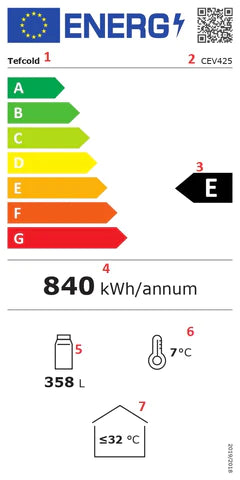
Explanations:
- Producer
- Model number
- Energy class
- Energy consumption per year (multiply this by the price for 1 kW to calculate electricity costs)
- Number of liters it has been tested with
- Temperature it is tested at
- Ambient temperature
2. A+++ to G: professional refrigerators and freezers (e.g. stainless storage refrigerator)
This energy classification goes from A+++ to G, and must be used on professional refrigerators and freezers that have a built-in compressor-driven cooling system and a cooling capacity of up to and including 300 kg of food.
However, products for display and sale of food (commercial fridge-freezer equipment) are not covered. Chest freezers, built-in refrigerators/freezers, roll-in refrigerators/freezers and walk-through refrigerators/freezers as well as products manufactured mainly for processing and thawing food are also exempt.

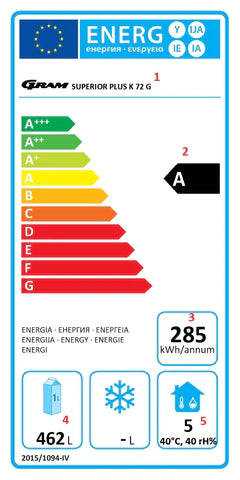
- Manufacturer and model name
- Energy class
- Energy consumption per year (multiply this by the price for 1 kW to calculate electricity costs)
- Number of liters it has been tested with
- Climate class, as well as maximum ambient temperature and humidity.
If an item does not have an energy label
If there is an item that does not have an energy label, it is either because it is not subject to energy labeling requirements, or because an error has occurred. In that case, you can contact us for more information.
What is climate class?
We often note the climate class on our refrigerators. With the climate class, you can see under which conditions the product works. This is important if your fridge is to be in a hot kitchen next to hot appliances, and not least if you open the fridge often. If the climate class does not match the real conditions, you may risk an excessively high temperature in the cabinet.


